The inflectorate: UK religious identity at a tipping point
This article analyses the demographics of UK religious identity through the lens of electoral dynamics, examining each parliamentary constituency by profiling the predominant religious identities of their local electorates and projecting how these will change.


In 2024, Labour won a landslide majority at the general election, securing 63% of the UK’s 650 constituencies with 34% of votes cast. The Conservatives won 24% of the vote but just 19% of the seats. Labour had been rewarded and the Tories punished by the dynamics of first-past-the-post (FPTP), a non-linear electoral system which can attribute seats in a highly disproportionate fashion.
Party politics was starting to fragment in 2024, and this fragmentation has continued. With several viable parties in most areas, small shifts in vote share for any party could lead to big changes in the number of seats they win at the next election. The dynamics of FPTP are volatile, with inflections and tipping points at play: below these thresholds, parties win very few seats; cross them and they may win hundreds.
In this context, building an electoral coalition is critical.
Religious identity and the populist right
Populist parties invoke various forms of identity in their attempt to build such coalitions, and over the last two years religious identity has come to the fore, with an assertive Christian nationalism growing in the US and now being imported to the UK.
As Dr Daniele G. Palmer of the University of Cambridge writes, two of Reform UK’s key thinkers – Cambridge academic James Orr and Tory defector Danny Kruger MP – are leading the cross-atlantic transposition of this ideology, with a stated belief that “Christianity ought to serve as the foundation of a new national order.”
But is there any basis for thinking this approach will work? Dr Palmer argues qualitatively that it will not, making the case that Christian identity in the UK “provides the veneer of coherence where there is none”.
The UK's religious identity is at an inflection point
This article takes a complementary, quantitative approach, analysing the demographics of UK religious identity through the lens of electoral dynamics.
Specifically, it examines each of the 650 constituencies in the UK, profiling the predominant religious identities of their local electorates and projecting how these will change.
This analysis reveals that a striking change is underway: when Labour won its landslide in 2024, 71% of UK parliamentary constituencies had a plurality of Christian voters. By 2029, 76% of these seats will be plurality non-religious.
The popcorn effect
Non-linear systems can be found throughout nature, society and popular culture. The outputs of these systems – such as the number of seats returned to each party by FPTP – are sensitive to small changes in their conditions.
Changes in output are often greatest around inflection or tipping points, reached at some threshold level of input. Popcorn provides a tangible example. The temperature at which a kernel will pop is determined by a few factors including its geometry, the strength of its outer hull and the amount of moisture it contains.
Natural variations in these factors lead to a distribution of popping temperatures. If you steadily heat 650 popcorn kernels, nothing will happen for the first few minutes. Then a few early kernels will start to pop. The pop rate will increase – slowly at first, then rapidly – until around 30-45 seconds later an inflection point is reached: the pop rate peaks and then starts to reduce. A further 30-45 seconds later, only a few stubborn kernels remain unpopped.
To slightly stretch this analogy, if a change in the most common religious identity of a parliamentary constituency constitues a “pop” event, the peak pop rate of this process is occurring in the UK right now.
(A bit) like the variation in popcorn kernels’ geometry and moisture content, the UK’s 650 constituencies vary in their religious makeup: across the UK as a whole, the 2021 census found that the two biggest religious identities were Christian (46%) and non-religious (37%). This translated to 490 constituencies (75%) having a Christian plurality, 142 (23%) having a non-religious plurality and the remaining 18 having another religious identity as their largest group.
We are now half-way between that census and the next in 2031, and it is likely that non-religion has overtaken Christianity as the most common religious identity in the UK – indeed my previous article projected that this cross-over would have occurred in 2024.
Just as the rate of kernels popping reaches its peak when approximately half have already popped, crossing this inflection point at the national level translates into a peak in the rate of constituencies flipping their religious plurality. The animation below shows my projection of how this will play out.
Religion by constituency – whole population
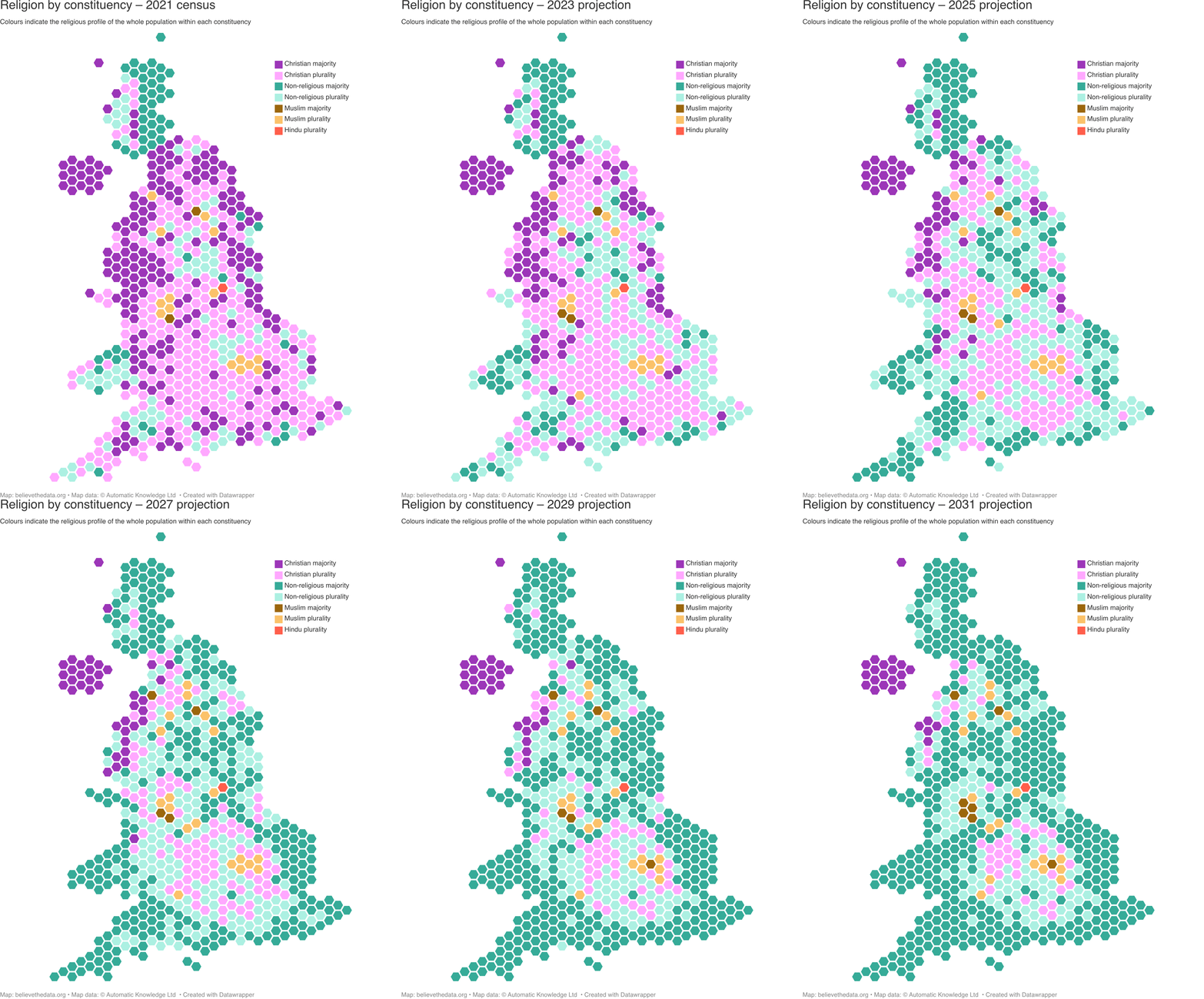
Watching the progression of religious identity over a ten year period, it is striking how the country transforms from largely Christian purple in 2021 to almost entirely non-religious teal in 2031, with Northern Ireland the only region to stay resolutely Christian throughout.
Here I map those projections to the UK’s 650 parliamentary constituencies by geographically apportioning LAD-level projections to constituencies using a simple formula weighted by area overlap.
I then correct for the errors this approach makes using adjustment factors based on 2021 data (when the actual populations for both area types were known exactly).
The full methodology can be viewed on github.
Projecting the electorate in 2029
The animation above shows the projected trend for the whole population, but to examine whether Christian nationalism is likely to have any quantitative basis for electoral support, we first need to narrow our analysis to those able to vote. As my previous analysis showed, the UK's youngest generations are less religious than the population as a whole. After removing these cohorts, we would therefore expect the remaining population – the electorate of adults aged 18 and over – to be slightly more religious.
The interactive chart below removes everyone aged 17 or less from the projected figures for 2024 and 2029, to show: i) the likely composition of the electorate for each seat at the next election; and ii) how it will have changed since the last one. Whilst it retains slightly more purple than the equivalent frame from the animation above, the overall picture remains clear: UK voters' religious identity will have categorically changed between the two election years.
Drilling into the detail of this map uncovers many local stories, possibly the most eye-catching of which can be seen in Clacton. Here, my model projects that Nigel Farage's seat will be one of 22 that, in just five years, go from having an electorate with a Christian majority to one with a non-religious majority, in this case with a swing of just under 9%.
Many of the other seats in this category can be found in the North East, where similar swings of 9-10% can be found. Hartlepool and North Durham are examples.
Other areas show different patterns. In seats which had Muslim pluralities in 2024, these are generally consolidated, as populations that are typically more youthful than average come of voting age. In Shabana Mahmood’s seat, Birmingham Ladywood, the scale of this change is enough to transform the electorate to a Muslim majority. Wes Streeting’s London seat, Ilford North, is one of two that transform from Christian to Muslim pluralities, although the absolute changes in share are small.
London has many of the smallest changes in profile. Over half of the 30 seats with the smallest swings from Christian to non-religious identification can be found here, with many of the others in rural Northern Ireland (where these swings represent much bigger fractional changes). London’s Christian population – more ethnically and culturally diverse than elsewhere in the country – appears more resilient to erosion.
It is notable that every single seat in the country is projected to have a reduction in Christian identification. This is partly due to my projection methodology which extrapolates trends seen over the last 20 years, but nevertheless highlights the fact that no area has been immune from decline over this period.
Finally, Danny Kruger may be interested to observe my projections for his seat in East Wiltshire. Here, an electorate with a slight majority of Christians in 2024 will, by 2029, be close to majority non-religious. He may consequently find that selling his brand of Christian nationalism under the banner of a new party may be a hard sell on many doorsteps.
The big picture at party level: all boats rise (and fall) with the tide
Zooming back out from individual constituencies to the national level, we can ask whether different patterns of religious demographic are visible by party.
In particular, to riff on a well-worn description of the Church of England, is the Conservative Party still at prayer in the 116 constituencies it still holds? And does Danny Kruger’s embrace of a moral rhetoric anchored in Christianity reflect the profile of the 8 seats now held by his party, Reform UK?
The short answer to these questions is no. Outside of London and Northern Ireland, the pattern is remarkably similar across each party’s electoral estate. Three quarters of the seats currently held by the Conservatives and Reform UK will have non-Christian pluralities in 2029, just short of the 79% national average. For Labour, that figure is 78%, for the Lib Dems it is 93%.
Caveats and conclusions
Whilst this analysis projects that the UK electorate is undergoing a profound change of religious identity, this will not necessarily translate into those who actually choose to exercise their vote.
Older voters are on average more likely to be Christian, and tend to be more likely to vote. Weighting the electorate by propensity to vote could therefore act in a similar way to removing the underage population. However, as with that change, it is likely that it would shift the tipping point back by a year or two. Beyond that, the overall story will not change much, and the relative change between elections in any adjusted number will still be just as significant.
Regarding the nature of religious identification, there are also important differences between belief, practice and identity or "belonging".
The analysis presented here is based on the response to census questions which ask "what religion are you?" (or a slight variation on these words) across each region of the UK. The aspect of identity this relates to is ambiguous, but most analysts assume that respondents map this question to belief.
If we accept this assumption (in addition to the key modelling assumption that trends seen over the last two census periods will continue throughout the current one), we can be fairly sure that religious belief is in decline.
Practice is also clearly declining. The Church of England keep comprehensive Statistics for Mission, as do other large churches. These show stable and linear declines in attendance, which following Covid have returned to their pre-pandemic trends. And although the Bible Society's "Quiet Revival" report initially appeared to contradict these statistics by revealing an uptick in church attendance amongst young men, this report has now been retracted following an admission of methodological error by YouGov.
That leaves identity and the idea of belonging, or as Daniele Palmer characterises it "Christianity not so much as a repository of ideas but as a marker of identity". Could attachment to the idea of religion as underpinning our ancestral heritage and moral code bind a coalition together even in the absence of belief or practice?
Without quantitative evidence, here we must rely on Palmer's analysis, which concludes that such a coalition is likely to be illusory:
a story that flounders between race and ethnicity, creed and crown, past and present...all Christianity provides is the veneer of coherence where there is none
More fizzle than pop
Whilst there are many factors that compete with identity to motivate voter's choices, populists are often keen to raise its salience to the top of the list.
My analysis here examined the viability of this strategy with regard to one particular aspect of identity, religion, asking whether the underlying conditions exist for a form of Christian nationalism here in the UK.
In doing so, it revealed that that these conditions are disappearing rapidly, if they ever existed at all. In fact we are currently in the middle of a remarkable shift in religious identity, far less visible than the upheaval taking place in party politics, but which could prove just as important over the longer term.
Explore the constituency-level data in detail
Thanks for reading this far! If you'd like to explore the data further, you can search the table below for a particlar constituency, party or MP name. You can also sort the columns.
If you want to go further than that and create your own projections, all the code and data behind the analysis here is available to run, copy and modify on github.
And if you've enjoyed reading, please consider subscribing (via the button below), or following for updates on Bluesky.